
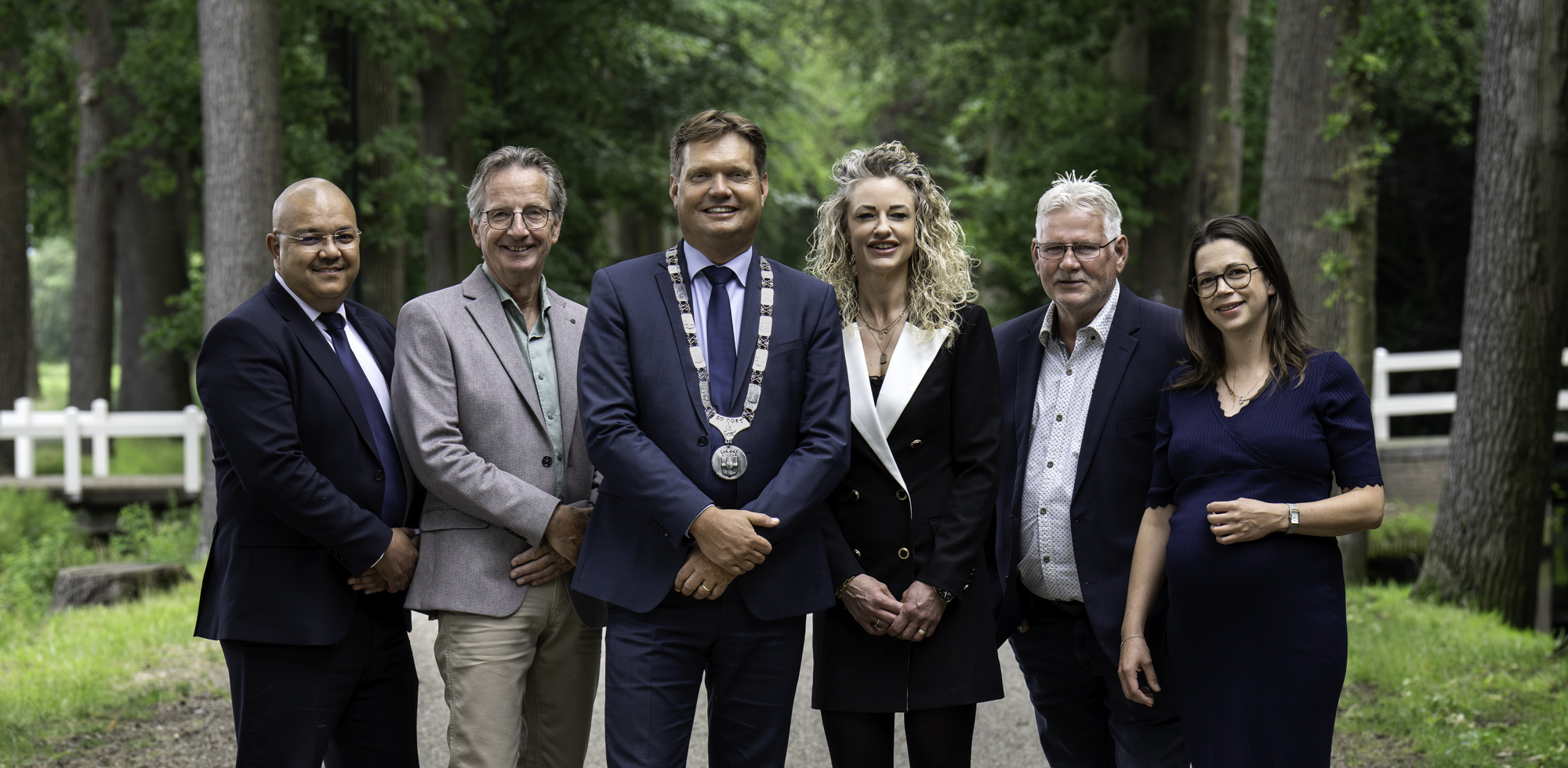
Board of B&W
Gehighlighte text: The College of Mayor and Aldermen (B&W) is the day-to-day management of the municipality and implements the policies (in outline) adopted by the municipal council. For this, the college is accountable to the municipal council.
The college of Gemert-Bakel consists of the mayor, four aldermen and the municipal secretary. The secretary supports the college in its work. The mayor chairs both the college and the municipal council.
Would you like to see a decision list? Or learn more about the portfolios of the mayor and aldermen?
On this page you will find more information about this. As well as the budget, declarations B&W and consultation hours of the college. Every week, an up-to-date decision list is published which contains the decisions of the college B&W(external link).


Budget, framework memorandum and annual report
2027 Budget
Income and expenses
What do we spend the money on?
| Governance and support | € 20.730.000 |
| Safety | € 4.118.000 |
| Traffic and transportation | € 6.611.000 |
| Economics | € 2.311.000 |
| Education | € 5.048.000 |
| Sports, culture and recreation | € 10.930.000 |
| Social Domain | € 46.769.000 |
| Public health and environment | € 11.855.000 |
| Housing, environment and urban renewal | € 10.406.000 |
Where does the money come from?
| Central government | € 84.853.000 |
| Local levies and taxes | € 22.130.000 |
| Land exploitation | € 5.742.000 |
| Other income | € 6.516.000 |
Affordable housing in all communities
Everyone should be able to find a pleasant place to live in Gemert-Bakel. That is why we are building affordable and suitable housing in all neighborhoods, with a special focus on young people, first-time homebuyers, and seniors. Our municipality is growing to 35,000 residents. Together with the national government and the province, we have agreed that 4,000 new homes will be built between 2022 and 2040. The Goed Wonen housing authority is a key partner in this effort.
Outlying area with perspective
The rural areas are changing. Many agricultural businesses are closing, and buildings are standing empty. Through the “Rural Areas with a Future” initiative and the transition fund, we’re helping business owners and property owners develop new plans. We’re relaxing the visual quality plan so that projects can be implemented more quickly. In doing so, we’re paying special attention to nature. Each year, we guide ten businesses toward future-proof operations.
Good school buildings
Children deserve a pleasant and modern place to learn. We are carrying out the ongoing projects from the school facilities plan as agreed. In 2027, we will finalize the design for the new children’s center in Donkheide. The contractor will be selected by the end of 2027. We are also working with partners on the plans for the Pandelaar and updating the school facilities plan.
Fewer rules, more freedom
Regulations are necessary, but sometimes they unnecessarily hinder entrepreneurs, organizations, and residents. That is why we will launch a regulatory burden help desk in 2027. There, they can report redundant or obstructive regulations and explain why. We will then examine how things can be improved or simplified. We’re also evaluating our procurement and bidding policies in collaboration with business associations. Businesses will also be given—literally—more space. We remain committed to expanding industrial parks and are seeking innovative solutions to address grid congestion at business locations.
Neighborhood-Focused Approach
We are strengthening village- and neighborhood-focused initiatives so that residents can meet and connect with one another more easily. By fostering better collaboration between professionals and volunteer organizations, we are building a stronger social foundation in our villages and neighborhoods.
Cost per household
Housing must remain affordable; this is a key priority. That is why the Municipal Executive has decided to adjust the property tax (OZB) in 2027 solely based on the inflation rate of 2.85%. The waste collection fee will also increase only in line with inflation, and the sewerage fee will increase by 5.2% on top of inflation.
