
Japanese knotweed
Asian knotweed is a collective term for various species of knotweed. Japanese knotweed is the best known of these. This plant is not native to the Netherlands.
The plant grows quickly and spreads easily. As a result, other plants have less room to grow. The plant can also cause damage to roads, sidewalks, cables, pipes, and buildings. It is therefore important to address the problem in a timely manner.
How can you identify Japanese knotweed?
The plant looks different in every season.
Spring
In the spring, red shoots emerge from the ground. These grow quickly. In a short time, the plant can reach a height of more than one meter.
Summer
In the summer, the plant is tall and green. The stems resemble bamboo. They are green with red spots. The leaves are large and oval. They grow alternately along the stem.
Fall
In the fall, the plant produces white flower plumes. The leaves often remain green until the first frost.
Winter
In winter, the above-ground parts die off. The brown stems often remain standing. Below ground, the roots continue to live. In the spring, the plant grows back again.
This is what the plant looks like:
This is what the plant looks like:
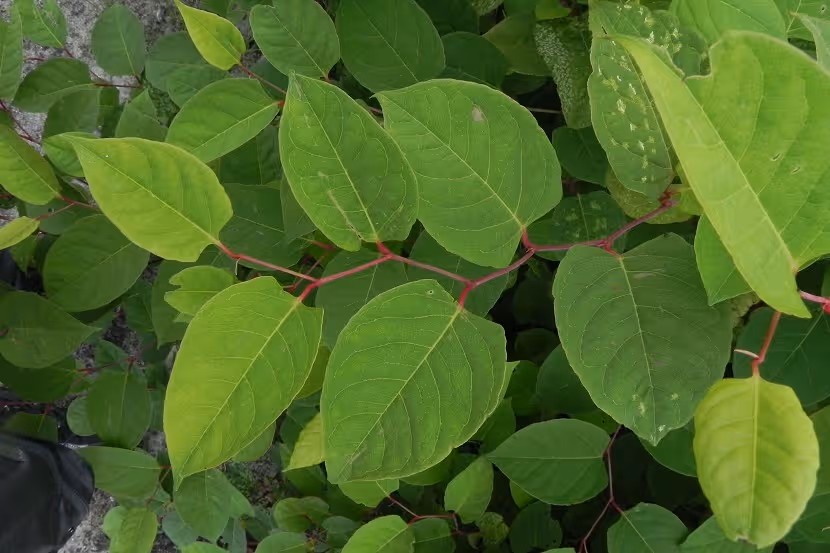
Leaves of Japanese knotweed
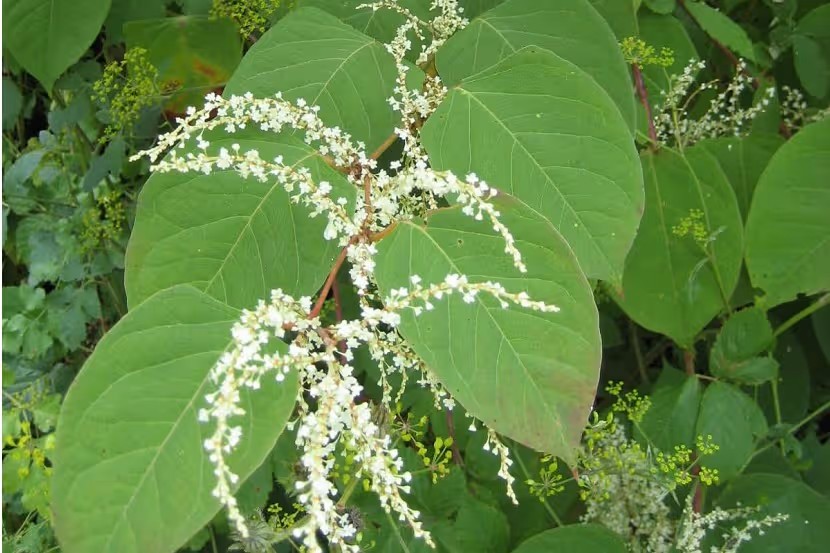
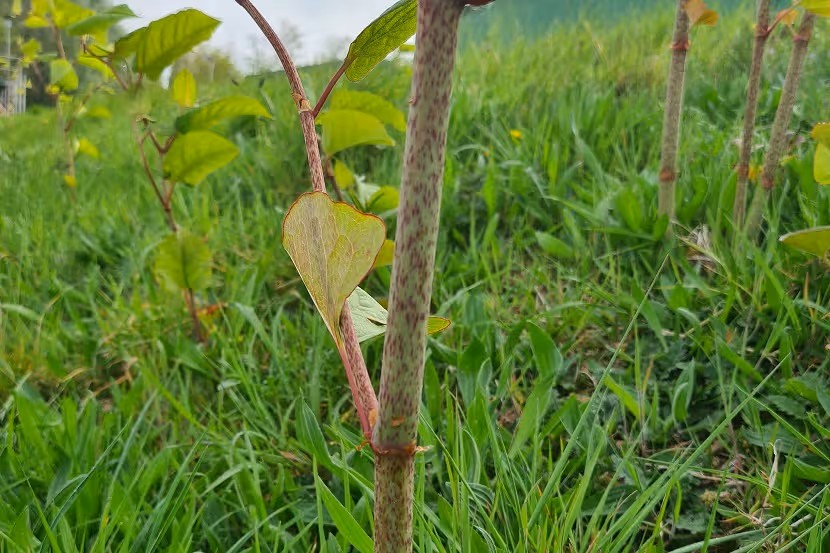
Stem of Japanese knotweed
What should you do if this plant is in your garden?
Report it to the municipality
Is there Japanese knotweed in your garden? Please report this by phone to the municipality. This way, we know where the plant is found.
Be sure to tell your neighbors, too. The plant can spread to other gardens through its roots.
Remove it yourself
You can control the plant yourself.
- Pull out or cut off new shoots as soon as they emerge from the ground.
- Remove as many roots as possible from the ground.
- Check regularly to see if any new shoots are growing.
Notice: Even a small piece of root or stem can grow into a new plant. That is why it is often necessary to control the plant for several years.
Dispose of plant waste in the gray bin
Dispose of all plant waste with the general waste in your gray bin.
- Put the plant debris in a trash bag and tie it shut tightly.
- Put the trash bag in the general waste, in the gray bin.
Do not throw the plant in the green bin, on a compost pile, or in a yard waste bin. Even small pieces of the plant can start growing again, causing it to spread further.
What is the municipality doing?
The municipality is combating Japanese knotweed on municipal land and in public spaces.
If you see this plant in a park, along a road, or in another public place, please report it to the municipality. We will assess the situation and determine what action is needed.
For more information about Japanese knotweed, visit the NVWA website(external link) (Netherlands Food and Consumer Product Safety Authority).