
Policy plan for street furniture municipality of Gemert-Bakel
2025-2034
Introduction
The municipality of Gemert-Bakel is responsible for the management and maintenance of municipal street furniture. This chapter explains how this document came about and the purpose of this policy plan.
1.1 Rationale
The municipality of Gemert-Bakel did not yet have a policy and management plan for street furniture in public spaces. This meant that there was no clear structure and organization around the management and maintenance of these objects. There was also a lack of clarity on what is and is not allowed regarding street furniture in public space. There is a need for uniform policy rules for placing and removing street furniture. For this reason, a policy and management plan for street furniture has been drawn up.
The document thus provides for the first time concrete policy, management and maintenance of street furniture for the municipality of Gemert-Bakel.
In addition to providing guidance to the internal organization, the intent of this document is also to show residents what is possible in terms of street furniture in public spaces and that we as a municipality believe it is important to maintain street furniture properly.
1.2 Purpose
The purpose of this report is to establish the policy principles for street furniture. This creates a clear structure and organization for these objects. In addition, the policy frameworks contribute to a structured handling of requests from residents regarding street furniture.
1.3 Central question
How can policy principles for street furniture be established to create a clear structure and organization of these objects, and how do they contribute to a structured handling of residents' requests?
1.4 Delineation
Street furniture comes in many shapes and sizes and is part of the design of public space. In Gemert-Bakel, by street furniture we mean a number of objects located in the public space. For this policy document, the scope is delineated to:
- Abri (bus shelter);
- Trash receptacle (single bin, double bin, can bin, paper bin, dog waste bin);
- Bicycle parking facility (bicycle (lean-to) bracket, bicycle abri, bicycle rack; bicycle clamp);
- Planter / greenery (planter with perennial or changing plantings);
- Information kiosk;
- Table (single table, picnic table);
- Flagpole;
- Seating element (street bench, seat wall).
Traffic facilities are excluded from this because they are subject to specific laws and regulations that do not apply to other street furniture.
1.5 Reading Guide
The street furniture policy plan has been prepared for the period 2025-2034. The policy plan is part of a broader policy and management plan, with the management plan covering a six-year period (2025-2030). Below is an overview of the contents of this document:
- Chapter 1: Introduction
In this chapter you will read about the reason for the policy plan, the objectives it seeks to achieve, the central question being answered, and the delineation of the plan. - Chapter 2: Laws and regulations
This section discusses the relevant laws and regulations applicable to street furniture. - Chapter 3: Current situation
This is where the current amount of street furniture is mapped, how it works and the trends in it are discussed. - Chapters 4 to 6: Policy frameworks
These chapters contain the policy and quality frameworks specific to street furniture. They describe the guidelines and principles for the next ten years. - Chapter 7: Appendix
The appendix explains the quality standards, structure of a sample agreement and additional information to clarify street furniture.
Legal frameworks
This chapter discusses the legal frameworks, guidelines and municipal policies related to street furniture.
2.1 National laws and regulations
When placing, managing and maintaining street furniture, laws and regulations are taken into account.
Relevant legal frameworks are:
- Constitution (Article 21);
The concern of the (local) government is for the habitability of the land and the protection and improvement of the environment.
- Civil Code (Article 6:174);
The municipality is liable for negligent maintenance.
- Provincial and Municipal Budget and Accountability Decree (BBV);
In accordance with the Municipalities Act, the municipality is required to prepare annual budget and accountability documents. The BBV contains regulations for this purpose.
- Environment Act;
With the Environment Act, the government wants to simplify and merge the rules for spatial development.
2.2 Guidelines
With legislation, it is clear that it must be adhered to. In the case of directives, too, it is only permissible to deviate from them if reasons are given. Case law has shown that the guidelines of the CROW in particular are an important testing instrument to which judges will adhere in disputes. The CROW is an independent knowledge organization that invests in knowledge in the field of infrastructure, public space, traffic & transport and work & safety. The CROW has issued several publications containing guidelines for maintaining and placing street furniture. The most important ones for street furniture are:
- Handbook of liability management public space CROW publication 185
- Accessibility guideline CROW publication 337
- Guideline on bicycle parking CROW publication 291
- Basic guide to litter bins in public spaces CROW publication 209
- Public space quality catalog CROW publication 380
2.3 Municipal frameworks
Performing management and maintenance of street furniture is based on legal frameworks, as well as frameworks and objectives imposed by the municipality itself. In the context of this policy, spatial and technical frameworks are important;
Spatial frameworks:
- Handbook of Public Space Design (HOOR).
The Public Space Design Manual (HOOR) forms a guideline for quality assurance of public space in the municipality of Gemert-Bakel. The HOOR consists of policy objectives, preconditions, standards, requirements, recommendations and profiles. Specific preconditions can be formulated per task, which are provided at the start of the design task. The HOOR is not a policy document, but summarizes the policy adopted by the municipality on functions in public space.
- Municipal Environmental Vision and Environmental Plans.
This vision contains the desired developments for the municipality. This vision forms the touchstone for policy decisions and provides direction for their implementation. This policy plan makes the goals of the environmental vision practical. In addition, each municipality has an environmental plan. The environmental vision and the environmental plan of the municipality of Gemert-Bakel are still under development.
Technical frameworks:
- General Local Government Ordinance (APV).
The APV describes various local rules relating to public spaces, such as the General Local Bye-Law (APV) which describes that it is forbidden to climb on street furniture (Article 2:47).
- Representation note
The Representation Note of Gemert-Bakel includes a rule about placing a bench when a person in the municipality turns 100 years old, a so-called "centennial bench" is placed at a location in consultation with and at the direction of the birthday person.
- Dog Policy
In the dog policy a number of rules have been set about litter bins. For example, it is included that every resident who lives within the built-up area of Gemert-Bakel has a waste bin within 400 meters of his/her home, so that they can easily dispose of dog waste bags.
- Play and exercise friendly space policy plan
The play policy includes the following about benches: aim for a bench every 300 meters, as a resting and meeting point. The closer to a facility the shorter the distance between benches.
Current situation
This chapter provides insight into the size of the area of street furniture owned by the municipality of Gemert-Bakel. This will be discussed in more detail in the management plan. In addition, the current situation is portrayed and trends and developments are discussed.
3.1 Size of acreage
Management data on street furniture can be maintained in the municipality's management system. Table 1 shows the numbers.
| Type of street furniture | Number of pieces |
| ABRI | 25 |
| Waste Bin | 348 |
| Bicycle parking facility | 754 |
| Planter | 32 |
| Information kiosk | 29 |
| Table | 80 |
| Flagpole | 73 |
| Seat element | 326 |
| Total | 1.667 |
3.2 Current situation
The following outlines how Gemert-Bakel deals with street furniture.
The municipality of Gemert-Bakel does not have a formal policy or management plan for this. As a result, there is currently a lack of clarity regarding the criteria for placing street furniture in public spaces and the procedures for handling citizen initiatives and/or integrating new developments.
Requests for placement of street furniture are submitted to various departments; the field service is in charge of placement. This procedure has resulted in an increase in benches and trash receptacles in recent years. This has been accompanied by increased management costs and impact on the visual quality of the environment.
3.3 Trends and developments
- Citizen participation:
Citizen participation is a growing trend where citizens are actively involved in policy-making and decision-making at the local level. It is the same with street furniture. Removing or placing a bench without notice can have a great impact on residents or the environment. In Gemert-Bakel it also happens that residents or an association take the initiative to place street furniture.
- Digitization:
The digital transition is happening at a rapid pace. For setting policy frameworks and management and maintenance of street furniture, it is also important to keep up with the digital transition. For example, the condition of street furniture can be loaded directly into the management system and data can be collected to discover patterns, save costs and plan maintenance.
- Sustainability:
By 2050, Gemert-Bakel must be CO2 neutral. To combat climate change, we must reduce CO2 emissions. In this policy and management plan, choices are also made to promote sustainability. These include:
- Material selection and longevity of materials (as raw materials become increasingly scarce);
- How production takes place (energy consumption);
- Logistical processes surrounding transportation and placing;
- Maintenance (frequency).
Vision and Mission
With the environmental vision, the municipality gives direction to the desired long-term quality of the physical environment. Policy on the physical environment is linked to this. This policy plan translates the goals of the environmental vision into practice.
Part 2 (building blocks) of the draft environmental vision states that residents consider it important that there are facilities in public spaces for relaxing, playing, sports and meeting, that the living environment is green, promotes health and is tailored to different target groups, and facilities are accessible and safe.
4.1 Street furniture vision
A recognizable and functional public space that serves the community includes attractive, durable and accessible street furniture.
4.2 Street furniture mission
Our mission is that street furniture contributes to a safe and attractive living environment both within built-up areas and in outlying areas. To this end, we ensure that street furniture is whole and clean. The municipality of Gemert-Bakel strives for uniformity in the placement and maintenance of street furniture but also recognizes the need for customization in new developments.
General policy principles
5.1 Citizen participation
The municipality of Gemert-Bakel regularly places street furniture in new construction projects and redesigns/reconstructions of environments. Removal of street furniture mainly takes place in existing situations, when the furniture is redundant or replaced. Depending on the situation, the municipality informs residents about the placement or removal of street furniture.
In addition to the municipality placing street furniture on its own initiative, requests are regularly received from residents or associations to place or remove street furniture. Requests to place or remove street furniture are coordinated with the supervisor of the neighborhood and surrounding area, and must be in accordance with the applicable policy frameworks. If street furniture is placed and maintained from a citizen initiative, clear agreements must be laid down in a management and maintenance agreement drawn up for this purpose (see example Appendix2).
5.2 Sustainability
Street furniture is often cited as an example when talking about circular economy. Benches, and litter bins are seen all the time in public spaces and are real eye-catchers. For this reason, they are well suited to send a signal to residents to show that the municipality is working on sustainability. This signal also poses a risk because the lifespan, vandalism resistance and quality of such new products will not be known for several years. The municipality wants to promote sustainability and circularity in street furniture through selection on:
- Sustainability performance of companies in the procurement process.
- Reusability, movable if the composition of the area changes so that a facility can be placed elsewhere.
- Materials with a long life cycle.
- Climate adaptation: a natural environment around street furniture to prevent heat stress/water flooding.
- Maintenance promotes repair rather than replacement.
5.3 Quality level
CROW's Public Space Quality Catalog offers a system to classify the quality of objects in public space (see example Appendix 1). For each criterion a choice can be made from five quality levels, ranging from very good (A+) to bad (D).
In the municipality of Gemert-Bakel, quality level B is used as the starting point for the management and maintenance of street furniture. This quality level guarantees a uniform and unambiguous image quality in the public space. For the center areas of Gemert and Bakel the ambition is to realize a higher quality level (level A), appropriate to the appearance and intensive use in these areas. This transition to quality level A will be carried out in stages. Initially, efforts will be made to achieve and guarantee quality level B in the center areas, as established in the management plan. Based on evaluations and possible additional measures, it will be determined what investments and efforts are needed to make the transition to quality level A possible. The results will be included in a future management plan. With this phased approach, the ambition remains achievable.
Policy criteria by type of object
6.1 Bench / Picnic table
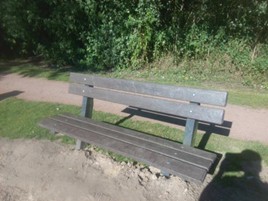
A bench or picnic table is more than just a seating area, it also contributes to the quality of the outdoor space and invites people to meet and stay outside. General policy criteria have been drawn up for placing and managing benches and picnic tables. Different policy criteria apply to the built-up area and the outdoor area.
General policy principles:
- The municipality determines the type of bench or picnic table based on management considerations;
- Functionality and Use: Benches/ picnic table should be placed in locations where there is a need for resting, meeting or relaxation areas;
- Accessibility: benches/picnic tables should be accessible to all users, including people with disabilities. For example, they should provide adequate space for wheelchairs;
- Safety: The placement of benches/picnic tables should not impede traffic safety or the flow of pedestrians and bicyclists. Benches should be placed at a safe distance from roads and bicycle paths. In addition, an analysis of the potential for both human and environmental nuisance will be conducted for the proposed location of the bench.
Built-up area:
- Benches only in plazas, parks, near playground equipment, sports facilities, at bus stops, along hiking and biking nodes*, along recreational hot spots, center locations;
- Every resident who lives within the built-up area of Gemert-Bakel will find a bench/seating area within a radius of 400 meters to support rest facilities;
- Picnic tables: only at recreational hot spots and playgrounds;
- Sufficient physical space for bench/picnic table: If there is not enough space, a bench/picnic table will not be placed.
Outlying area:
- Benches and picnic tables only at hiking and biking nodes* and recreational hot spots.
*Walking and cycling junctions: benches and picnic tables are only placed at an information panel of the Brabant cycling and walking route network: The most beautiful cycling routes in North Brabant | VisitBrabant(external link) The most beautiful hiking trails in North Brabant | VisitBrabant(external link)
6.2 Waste bins
In principle, waste bins are unnecessary. The resident himself is responsible for the waste released on the road and should take it to his home and dispose of it (separately) there. This is not always reasonable, which is why predictable places should also be provided where the resident can dispose of their waste along the way. The predictability of these places is important, so that the resident on the street knows where to go with his waste the moment it is released. This prevents litter. Knowing where citizens on the street can go with their waste works preventively and prevents litter. Spreading this knowledge is part of the integral communication about litter. Knowledge organization CROW and Nederland Schoon have provided a basic guideline for placing litter bins in public spaces in a publication 'litter bins in public spaces'. The strategies for placing litter bins are based on the themes of findability, ease of use, attractiveness and awareness. The policies in this section were created using this document, applied to the municipal situation. The municipality of Gemert-Bakel can use these guidelines to guide the development of the stock of litter bins within the municipality.
General policy principles:
- Litter bins prevent litter but also attract (litter); a litter bin should be used for its intended purpose
Litter bins help reduce street litter. It allows people who want to deal responsibly with their (consumer) waste to dispose of it properly. On the other hand, the practical experience is that a litter bin also (can) lead to litter next to the bin, especially in locations that are less visible. A litter bin can also attract household or commercial waste, this is especially noticeable with the litter bins in the center of Gemert-Bakel. When the waste bin is used incorrectly, practical measures are taken to counteract misuse, for example with a reduced opening to counteract garbage bags. Where necessary, enforcement action is taken, informed, addressed and if necessary fined. In extreme cases, the bin is removed.
- Place waste bins where consumed or produced
Litter bins are placed where waste is generated: for example, through consumption or sale. Consumption involves locations such as playgrounds, walking trails, etc. Sales and production points are for example stores, restaurants etc. For sales and production points, the
trash cans the responsibility of business owners. They themselves are responsible for placing trash cans and keeping the immediate area clean.
- Where much litter is produced; keep clean
Keeping public spaces clean is a joint responsibility for municipality and users.
- Dog walking strips/running areas and nuisance
The municipality of Gemert-Bakel has a previously established dog policy. The dog walking areas are cleaned mechanically throughout the year. At dog walking areas signs indicate if there is an obligation to clean up. In places other than dog walking areas there is an obligation to clean up and a leash obligation. Every resident who lives within the built-up area of Gemert-Bakel has a waste bin within 400 meters of his/her home, so they can easily dispose of dog waste bags.
- Continue to use practical knowledge
The input of field staff is indispensable in the placement of litter bins. Their experience and knowledge is therefore utilized.
- Not a trash can everywhere
Municipality of Gemert-Bakel wants to encourage users of the public space to take and clean up their own waste. Therefore, litter bins are not placed everywhere. Because placing, maintaining and emptying a litter bin involves costs, the basic principle is: 'no, unless...'.
In principle, no more than one bin is placed at a location unless it does not make sense because of usage pressure or walking distance. This means, for example, that it is not necessary to place a litter bin at every bench. At a group of benches, a litter bin does fit.
Placement criteria:
Based on the foregoing principles, the existing situation is assessed. New requests are reviewed against this by the street furniture manager. A litter bin will not be placed at every location upon request. The request will be assessed according to the following placement criteria.
A trash can belongs in these places:
- In shopping centers (every 50 meters). Entrepreneurs themselves ensure the placement of (mobile) waste bins in the outdoor area and the timely and adequate cleaning of the area (within a radius of 25 m);
- Along snack and bike routes. Between schools and supermarkets you often see a lot of litter. We call this a candy route;
- One trash can at facilities for older youth (Youth meeting places/ skate facility);
- Trash can at play locations;
- At bus stops in downtown and at heavily used stops;
- In parks and parks only litter bins at the entrance unless the pressure in the park is great or the walking distance is very long;
- Every resident living within the built-up area of Gemert-Bakel will receive a litter bin within 400 meters of his/her home, so they can easily dispose of dog poop bags.
There are no trash cans in these places:
- Loose trash cans in residential streets;
- Within a radius of 10 m from public eating places, with the exception of places in shopping malls. Owners should provide their own litter bins and keep public areas clean (This will need to be enforced);
- In principle, no litter bins in the outlying area, with the exception of locations known to produce a lot of waste there. Recreant is expected to bring trash in the same manner in which he brought the container.
6.3 Bicycle parking facilities
The placement, removal and maintenance of bicycle parking facilities often comes down to customization, given the required capacity at a facility or activities in an area. CROW has drawn up the bicycle parking guideline. These guidelines contain the quality requirements for bicycle parking facilities. The municipality of Gemert-Bakel acts according to these guidelines (Standards Documents FietsParKeur version 2.5 July 2021(external link)). In addition, the municipality of Gemert-Bakel sets a number of general principles.
General principles:
- Bicycle parking facilities are only placed at public facilities, not at residences;
- Bicycle parking facilities are only placed in clusters not individually;
- The municipality shall bring uniformity to the type of bicycle parking facility.
6.4 Abri cars
An abri is a waiting area that provides shelter from rain and wind for travelers or passersby. Abri's are usually in locations where public transportation stops. Abri's must also be placed and maintained.
In order to determine which management variant is preferable, it is necessary to first determine when a stop "deserves" a bus shelter. Both line services and stops appear to be dynamic and in order to respond adequately to this, it is useful to have a yardstick with which to determine what a stop should meet.
An assessment framework has been drawn up in which the "need for a bus shelter" can be determined for each bus stop. This assessment framework has a number of starting points and a number of weighting factors.
General Principles:
- Every core with a bus route deserves an abri at "the center location."
- When a stop has a clear boarding and alighting side, the alighting side does not need a bus shelter (because traveler goes directly home/destination);
- No advertising columns and info signs in bus shelters;
- Abri's are "full glass." An abri should obscure as little view of its surroundings as possible;
- The bus stop name must be visible on the bus shelter.
The weighting factors:
- Sufficient boarders for abri;
- Stop for multiple bus lines;
- Already an abri present;
- Social importance;
- Environment distant abri;
- Sufficient physical space for abri.
The entire consideration framework is included in Appendix 3.
6.5 Planters
The municipality of Gemert-Bakel is reluctant to place planters in-house because the preference is for perennials/trees/flowers. However, at some locations or in special situations this is not possible. A planter in this case can be of added value to make the center more attractive. For planters in the public space, the municipality sets the following policy criteria:
- Planters only at center locations;
- The municipality determines the number and location of planters;
- Around the planter remains free space of at least 1 meter;
- The planter does not create a nuisance, hazard or damage to the surrounding area.
6.6 Information kiosk
Map boards and information boards can serve various functions such as, prevent search behavior, promote traffic safety, boost recreational destination ect. Nowadays, many residents carry a GPS but in some locations a map or information board is still desirable. The municipality sets the following policy criteria for map and information signs in public spaces managed by the municipality:
- The location of the sign should be commensurate with the nature and scale of the property or area to which this sign applies;
- Account will be taken of signs already in place in the vicinity, either temporarily or permanently;
- The sign should have a direct relationship to its surroundings;
- A clear space of at least 1 meter is left around the floor plan sign/information board;
- The quality of the design of the (caption of the) sign must be sufficient.
6.7 Flagpoles
The zoning plan, which is turning into the environmental plan, includes rules for flagpoles in a building yard. In public spaces, the placement of flagpoles is treated with restraint. No further policy criteria are established for this.
Appendix 1 Quality level CROW
| Level | Image | Quality |
| A+ | New condition | New |
| A | Comfortable | Good |
| B | Functional | Sufficient |
| C | Austere | Insufficient |
| D | Unsafe | Bad |
Table 2. Further explanation of image quality levels
Appendix 2 Sample management agreement for street furniture civic initiatives
Management and maintenance agreement street furniture civic initiatives
The municipality of Gemert-Bakel, for this purpose represented pursuant to article 171, first paragraph of the Municipal Law by the mayor, acting in execution of the resolution of the college of mayor and aldermen d.d. ....... , hereinafter referred to as: the municipality;
and
Citizens Initiative represented by ..........................., residing at ........................, and ...................................., residing at..................................,
have agreed that civic initiative.......... will manage and maintain....... To this end, the following arrangements have been made, which they wish to record in this written agreement to ensure the safety of the street furniture.
- The civic initiative .... will maintain the street furniture.
- The municipality conducts the inspections and provides feedback on required maintenance and repair work.
- The municipality takes care of the major maintenance of street furniture surfaces.
- If the civic initiative no longer maintains the street furniture, the municipality will act according to the dangling policy and management plan and/or the objects will be removed depending on the extent of the defect in relation to safety and legislation.
Thus made and agreed in Gemert-Bakel on ....................
Appendix 3 consideration framework for bus shelters
Abri's
Weighting points
| Item | Item | Yes/No | Weighting* | Note |
| 1 | Sufficient boarders for abri | 1 | ||
| 2 | Stop for multiple lines | 0,5 | ||
3
| Now an abri present | 0,25 | ||
| 4 | Social importance | 0,5 | E.g. bus stop near nursing home or sports facility | |
5
| Environment demands abri | 0,5 | E.g. center location or hub | |
| 6 | Sufficient physical space for abri | 1 | If here no, no abri |
*option sum 2.5 or higher = abri required
* Over the years, the weighting of an item may change.