
Yellow-legged Hornet (Asian Hornet)
The yellow-legged hornet is a species of wasp that does not occur naturally in the Netherlands. The species is being spotted more and more frequently, including in our municipality. The yellow-legged hornet can cause damage to nature and biodiversity, and poses a risk of stings if its nest is disturbed. The yellow-legged hornet aggressively defends its nest. We are therefore keeping a close eye on the species and taking measures to minimize its impact as much as possible.
How do you recognize an Asian hornet?
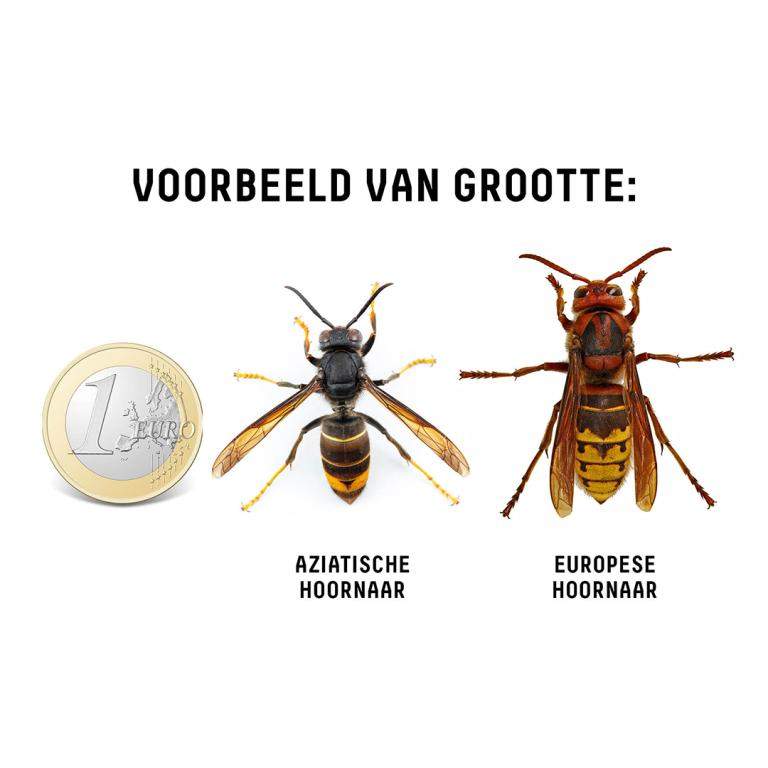
The Yellow-legged Hornet:
- Is 2 to 3 centimeters long.
- Has a black thorax.
- Has black feelers (antennae).
- Has yellow tips on the legs.
- Has a black abdomen with 2 narrow and 1 wide orange/yellow band.
- The queen and worker are about the same size.
How do you recognize a nest?
A yellow-legged hornet builds two types of nests:
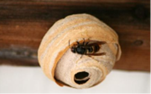
Spring nests (also called: primary nests)
- These nests are made in the spring.
- They are smaller, starting out about the size of a ping-pong ball
- They usually fly low, below 3 meters
- Nests are built under a canopy, in a shed, in a birdhouse, in a wall cavity, etc.
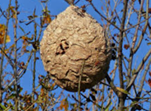
Summer nests (also: secondary nests)
- These nests are built in the summer (July/August)
- They are larger, about the size of a Skippy ball
- They usually hang high in trees
- They are aggressively defended.
Is the Asian hornet beetle dangerous?
- A nest that is left undisturbed is usually not dangerous. If you disturb a nest, it will be aggressively defended. This can happen even if you simply get too close to the nest.
- If a nest is disturbed, the yellow-legged hornet reacts much more aggressively than other wasps or the European hornet. There is a high chance that multiple hornets will sting you at once and chase you over a long distance. This increases the risk of an allergic reaction. In that case, contact a doctor as soon as possible and call 112.
- The yellow-legged hornet can also spray a liquid into your eyes. This can cause eye damage. If your eye is hit, you will lose your vision for one or several days.
- For children, one or more stings from the yellow-legged hornet pose a greater risk than for adults. If a child is stung, always consult a doctor.
Planning to prune your tree or hedge?
Before you start pruning, check to see if you can spot a yellow-legged hornet nest. This will reduce your chances of getting stung.
The yellow-legged hornet is certainly no small insect. If you look closely, you can often see the yellow-legged hornet flying back and forth from the nest even from a distance. If there is a nest or you suspect there might be one, keep your distance and report it to us via Public Space Report Form(external link).
What do you do if you see a nest?
In the spring (from March through about June), the yellow-legged hornet builds small nests about the size of a ping-pong ball. These are expanded into nests with a diameter of 20 to 30 cm. These nests are often located low to the ground and can be found in birdhouses, hedges, sheds, canopies, and cavity walls. If you see a spring nest, do the following:
- Please report the nest to us. You can do so by phone or email.
- We are sharing the contact information for the De Klaverbloem Beekeepers’ Association with you. You can contact them.
- Within a week, they will determine whether this is indeed a spring nest of the yellow-legged hornet.
- If it is a spring nest of this species, the bee association removes the nest if possible.
Can’t the beekeepers’ association remove the spring nest? Or is it a summer nest? If so, please contact us again. We’ll assess whether the nest can be removed.
Which nests are removed on behalf of the municipality?
Guidelines have been established regarding the situations in which nests are removed on behalf of the municipality. We may deviate from these guidelines. The pest control expert’s advice takes precedence.
In public areas, the municipality will have nests removed or vacuumed out in the following cases:
- A nest hanging lower than 10 meters.
- A nest hanging higher than 10 meters, within 10 meters of a public building or on/in public buildings.
- A nest hanging higher than 10 meters, within 10 meters of a location with high foot traffic (downtown areas) or high risks. Examples include playgrounds, schoolyards, or sports fields.
Learn more
More information about the yellow-legged hornet can be found on the website of the province of North Brabant.(external link)