
Financial reassessment road management 2024-2027
Colophon
Date: July 4, 2024
Case number: 8887-2023
Author: Claire Laudij, Public Management team
Project team: Martijn van der Lee, Dennis Schevers, Jeroen van Haaster
1. Introduction
A well-maintained network of roads and bicycle paths is essential for the accessibility of the municipality. The municipality has a maintenance obligation for its pavements and must ensure that they are of sufficient quality so that they are safe for users and can fulfill their functions.
Reason
In 2018, the current Roads Management Plan was adopted by the Gemert-Bakel Municipal Council. The Roads Management Plan 2018-2027 provides both the policy frameworks for the overall road maintenance of roads of the municipality, as well as the financial calculation in a management plan with a multi-year investment schedule.
The Roads Management Plan (hereafter WBP) was subject to a mid-term review[1] in 2022. The conclusion was that updating the substantive policies was not necessary. The principles in the policy plan are still perfectly workable. Wishes for more vision and details are there from the organization, but these will be included in the update of the policy in 2027.
The Budget and Accountability Decree for Provinces and Municipalities (BBV) stipulates that the management plan for roads must be reviewed every five years and look ahead a minimum of four years. Our own financial frameworks stipulate that we look at least ten years ahead for the provision. This involves only the financial review of management. This report describes that financial recalibration.
Target
The purpose of this management plan is to provide insight into the costs that need to be spent on maintenance in the coming management period in order to keep the area of roads safe and passable within the legal, administrative and financial frameworks. An up-to-date management plan is important to be able to include developments in price, legislation and maintenance status.
Frameworks
Especially important for road management are the regulations surrounding the Budget and Accountability Decree for Provinces and Municipalities (BBV). From the point of view of risk management and insight into the financial position, it is an obligation under the BBV to have an up-to-date management plan when there is a provision for maintenance, as is the case for roads. The province also tests for this.
This management plan has been prepared on the basis of the CROW publication Road Management 2011.
The other legal and administrative frameworks are explained in the WBP 2018-2027.
Scope
Road management focuses exclusively on the management and maintenance of existing pavements. Reconstructions, conversion or redesign are not part of it.
Management and maintenance in the context of road management takes place on all municipal pavements whereby a distinction is made according to pavement type and user:
- Closed pavements such as asphalt and concrete, for roads and bicycle paths;
- Open pavements such as paving and tiles, for roads, bicycle paths and footpaths;
- Semi-paving as rubble and gravel, for paths;
- And sand, in the case of agricultural and forest roads.
Outside the scope of this management plan are:
- Policy update;
- Pavements managed by third parties (e.g. province or private individuals);
- Cleaning pavements (e.g. street sweeping or weed control);
- Maintenance of verges;
- Maintenance of engineering structures such as bridges;
- Maintenance of art in public spaces;
- Traffic Safety.
Continuous process
Road management is an ongoing process. The adoption of this financial reassessment concerns a snapshot during this continuous (improvement) process. Also on the agenda this year is the Mobility Vision, in which choices will be submitted to the city council about the functions of roads, bicycle routes and the corresponding profiles and surfacing. These choices will have consequences for road management. After adoption of the Mobility Vision, where necessary, road management will be connected to the new vision. The full consequences will be included when the Roads Management Plan is updated in 2027. The coming years until the updating of the full policy document in 2027 will be used to catch up in management and maintenance, after which in 2027 a substantive battle can be struck with policy choices in the areas of mobility, sustainability, climate, innovation and the environment.
Reading Guide
Chapter 2 describes the quantity and quality of the acreage. Most of this data comes from the WBP 2018-2027. In Chapter 3 we describe the management strategy the municipality uses for road maintenance. In Chapter 4 we describe the financial effects on the operating budget, provision and investment appropriations due to the planned work in the coming years and what results we expect. Chapter 5 describes the conclusions. The appendices list the streets scheduled for project-based work in the coming years.
[1] see RIN "Evaluation Road Management Plan 2018-2027" dated November 15, 2022
2. Areal
The information on the area is (mainly) from the Road Management Plan 2018-2027. It describes the situation as it was in 2018. In the meantime, work has already taken place, so the current situation has already improved compared to 2018. A new inventory of the area will be carried out for the 2027 update.
Quantity
Pavement type
In the municipality of Gemert-Bakel there is a total surface area of over 2.6 million m² of pavements. In addition to roads with asphalt, element or cement concrete pavement, the municipality also has other semi-paved roads (such as shell paths) and roads without pavement (such as dirt roads).
Of the total area, 39% consists of asphalt pavement (dense asphalt concrete and surface treatment), 43% of elemental pavement (clinkers, tiles, etc.), 3% of concrete pavement, and 15% of other pavement (especially semi-paved and unpaved roads).
Pavement function
The table below shows the area per function.
| Area by function | Opp. (m2) | % |
| Driving lanes | 1.170.488 | 44 |
| Road in residential area | 961.878 | 37 |
| Footpaths | 283.804 | 11 |
| Bike paths | 211.758 | 8 |
| Other | 8.083 | <0,5 |
| Total | 2.636.011 | 100 |
Road type
The table below shows the area of roads per road type.
| Area by type of road | Opp. (m2) | % |
| Main road network | 0 | 0 |
| Heavily traveled road | 0 | 0 |
| Average loaded road | 373.657 | 14 |
| Lightly traveled road | 946.418 | 36 |
| Road in residential area | 825.551 | 32 |
| Road in residential area | 270.692 | 10 |
| Bike paths | 219.693 | 8 |
| Total | 2.636.011 | 100 |
Year of construction
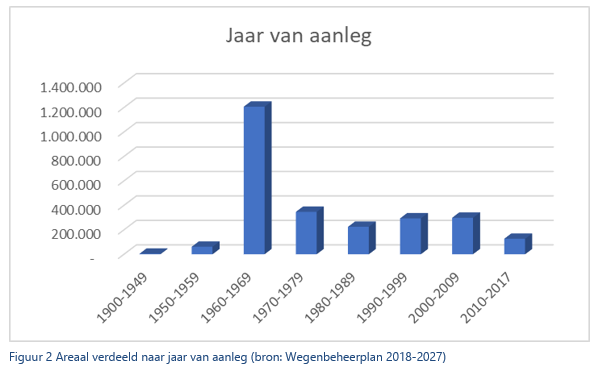
The figure below shows the number of roads divided by year of construction. Notable is the expansion of the amount of roads in the 1960s. When filling the management system, the year of construction was not always clear. These "unknown" roads were probably placed in the database in the period of the 1960s. In maintenance, we strive to "spread out" the replacement wave; leveling it out over a longer period of years to create a more even level of investment.
Figure 2 Area divided by year of construction (source: Roads Management Plan 2018-2027) see appendix
Quality
Image quality level
The most recent global-visual road inspection was carried out in November 2022 in accordance with CROW publication 146. The data used for this was taken from the road section file and the GBI management system. The inspection results were converted to a quality level in accordance with CROW publication 380. CROW uses quality levels A+ to D.
When roads are constructed they fall under quality level A+. Depending on various factors, the quality degrades to a lower level over time. Quality level A involves some damage, such as slight fraying. Quality level B presents a reasonably to well maintained appearance of the public space, but the roads are certainly not damage-free, any areas of repair are visible. At quality level C, maintenance is required within 2 years. At quality level D, there is backlog, risk of unsafe conditions and possible capital destruction.
Results road inspection
The table shows the image qualities measured in 2022 (top) along with the 2020 results (bottom). The 2022 road inspection data was cleaned up by the road authority. The cleanup consisted of removing duplicate road sections, road sections without dates and road sections not managed by the municipality, and some changes in the interpretation of the data.
| Image Quality 2022 | Description image | Asphalt | Eleme3ten | Concrete | Total |
| A+/A | very good/good | 76,0% | 75,5% | 95,4% | 75,5% |
| B | sufficient (basic quality) | 13,0% | 8,0% | 0,2% | 10,0% |
| C | moderate | 1,3% | 2,2% | 1,7% | 1,7% |
| D | too bad | 9,7% | 16,3% | 4,1% | 12,8% |
| 100,0% | 100,0% | 100,0% | 100,0% | ||
| |||||
| Image quality 2020 | Description image | Asphalt | Elements | Concrete | Total |
| A+/A | very good/good | 78,2% | 84,9% | 92,9% | 84,6% |
| B | sufficient (basic quality) | 10,7% | 4,4% | 6,1% | 5,3% |
| C | moderate | 3,0% | 1,4% | 0,0% | 1,8% |
| D | too bad | 8,1% | 9,3% | 1,0% | 8,3% |
| 100,0% | 100,0% | 100,0% | 100,0% |
The damage figures have increased in recent years from 10% roads with C and D levels (moderate and poor) in 2020 to over 14% in 2022. The biggest cause of this is a lack of capacity, particularly due to the lack of a permanent road authority until November 2022. Work has already taken place since November 2022 to reduce the percentage of C and D roads.
3. Management Strategy
Road management aims to maintain the current area of pavements so that they can be used safely by road users. Depending on the material of the road and the load on the road, it degrades in quality over its lifetime. By performing maintenance, the quality of the road is improved again so that it is safe to drive on until the road is completely replaced.
Ambition
In the Roads Management Plan we describe the basis for the maintenance of the pavements. The target quality level for roads is level A for sidewalks in the centers of Gemert and Bakel. This guarantees the safety for users and the accessibility of the municipality, at a socially acceptable cost level. With quality level A, the roads are well maintained, but some damage is allowed, such as slight fraying. For the remaining roads, quality level B applies. The quality level B focuses on deploying the right measure at the right time.
CROW methodology
Maintenance of pavements in the municipality of Gemert-Bakel is carried out on the basis of the CROW system. The desire is to use a combination of qualitative and cyclic maintenance.
Qualitative maintenance is used for short-term maintenance. The qualitative methodology uses the age (year of construction) of the pavement, inspection results, inspection date, guidelines, warning guidelines and behavioral models to determine whether maintenance measures are necessary.
The cyclical method has been developed for long-term planning and budgeting beyond the first 5 years. This is particularly necessary for asphalt roads; element roads remain of more continuous quality throughout their lifespan. Using national experience figures for guidelines, warning limits and key figures, a structural planning of measures takes place. This creates a multi-year planning and financial overview. Currently, this cyclical method is not yet used structurally, but the municipality will use this method in the future.
Maintenance cycle
The figure on the next page provides insight into the progression of quality over time and the impact of maintenance. Performing maintenance at the right time, with the right measures within the available resources is the challenge of road management. All this within the total task of public space and current themes and developments.
Daily minor maintenance
In the cycle of road management, roads will always require maintenance. Daily minor maintenance includes measures for emergencies as part of keeping roads "safe" and "whole" by fixing minor problems quickly. For example, potholes are repaired and verges are replenished.
Major maintenance
Major maintenance involves a larger road section being maintained, but without addressing the construction itself. An example of this maintenance is milling out bad sections and replacing a (partial) covering layer (asphalt) of a road. Within elements, for example, flatness is improved and tree root problems are permanently solved. A characteristic of this maintenance is that the measures are planned in a plan year and result from (in particular) road inspections. When major maintenance is postponed, more minor maintenance is required on roads
Reconstruction/redevelopment
Road reconstruction involves replacing the entire structure of a road, including the foundation. In reconstruction, the road is actually rebuilt. As much as possible, an attempt is made to combine this work with other trades. When reconstructions are delayed, more major road maintenance is required.
Methodology
In Gemert-Bakel we use the management system GBI.
Maintenance is determined on the basis of road inspections, which are carried out using the CROW system. The road inspection leads to the basic planning. In the basic planning, the results of the road inspection are processed into a list of required work. A road inspection consists of a global visual inspection in accordance with the CROW Manual Visual Inspection 146. We also regularly conduct our own inspections to check the measures from the basic planning.
On some of the roads from the basic planning, minor maintenance is sufficient. This work is carried out right away.
Major maintenance is incorporated in a budget planning. The maintenance measures prescribed as a result of the inspection are reviewed and prioritized based on need, budget, time and capacity. This creates a schedule with work for each plan year that can be put away to contractors.
When a road is completely redesigned or reconstructed, it is not put on the budget planning, but on the integral project planning. This planning is called multi-year investment planning (MIP). Work is coordinated in this planning with other disciplines such as sewer, green space and traffic.
The road inspection is repeated at least every two years and the schedule is updated accordingly.
Urgent and emergency maintenance, meanwhile, is carried out regularly based on reports and its own inspections.
Management planning is updated annually with the preparation of the new budget.
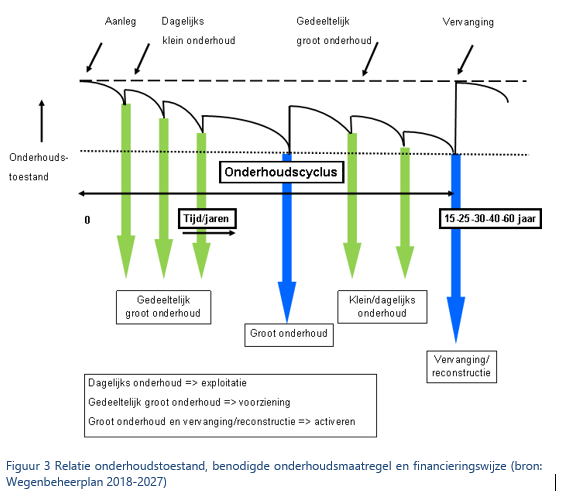
Figure 3: Relationship between maintenance condition, required maintenance measure and funding method (source: Road Management Plan 2018-2027)
4. Resources
From the Road Inspection 2022, a list of work has been prepared. This chapter gives the necessary resources needed to carry out these works. To do this, it first presents the assumptions on the basis of which the budgets were determined.
Principles
Below are the basic principles that are assumed for road maintenance. These principles are more recent than in the 2018 Roads Management Plan. If there are issues that conflict with the 2018-2027 WBP, the principles in this report apply.
General
- The target quality level for roads in the municipality of Gemert-Bakel is, in accordance with the Road Management Plan 2018-2027 (WBP), level A for footpaths, and pavements in the centers of Gemert and Bakel. Quality level B applies to the other pavements. This means that pavements must have at least this quality level, whereby, according to the CROW systematics, 10% of the roads may deviate negatively.
- No costs for future area expansion are included in this management plan. There are rules within the municipality's financial policy on the basis of which maintenance funds for new acreage are allocated annually to the budget;
- The first meter of the shoulder is an integral part of the road.
Daily minor maintenance (operation)
- Small maintenance includes: all roads < 200m2 of work, dirt roads, unpaved roads, small maintenance points from the road inspection, filling in the side pavement of the road, lowering verges for drainage;
- Regular items for daily maintenance are included in the operating budget;
- Indexation of the operating budget is included annually in the Framework Memorandum.
Major maintenance (provision)
- Major maintenance includes work of > 200m2 on the current infrastructure. Major maintenance does not include construction (foundations);
- Maintenance costs assume that the road is replaced with the same materials. Only within built-up areas is asphalt replaced with elements whenever possible to reduce heat stress, for water passability, and appearance. Elements are more expensive to construct, but because of the longer life of clinkers, this has no effect on annual depreciation costs. There is no structural policy on climate and sustainability yet. However, this will be included in 2027, when the policy plan is updated;
- Major maintenance is paid from the provision. The estimated multi-year expenditures have been indexed in this management plan;
- Where trees play a role in major maintenance charged to the provision, part of the cost is paid from the tree replacement budget. Cost sharing is determined on a bespoke basis between the road manager and tree manager for each maintenance project;
- There is a separate credit for the purchase of materials for element roads when there are not enough stones left to put back when maintenance is carried out (see also the explanation in the investment section);
- There is a separate credit for verge pavement for grass concrete tiles installed along a road during maintenance or reconstruction. Grass concrete tiles have a depreciation period of approximately 40 years and are therefore not paid from the provision (see also the explanation in the investment section).
Reconstruction/redevelopment (investments)
- A complete replacement of a road including construction (foundation) is a reconstruction. Also, when roads are reconstructed, they are charged to the investment;
- For replacement investments, a depreciation period of 60 years is calculated for element roads and sewers, and 40 years for asphalt roads. For the depreciation period of the various components of a reconstruction (e.g., trees along the road), we calculate with the same depreciation period as the road;
- For the unit prices in the MIP we calculate with the prices from the GBI 2013 indexed with the GWW index. The MIP is recalculated annually;
- We strive to convert as many roads as possible within the built-up area to 30 km/h. Outside built-up areas, we aim to maintain municipal roads at or convert them to 60 km/h. The effects on the budget will be involved in the implementation program accompanying the Mobility Vision. Traffic measures have a shorter depreciation period than roads. This can increase the operating costs of roads. A proposal for this will be made in the Mobility Vision;
- There is a separate credit for the purchase of materials for element roads when there are not enough stones left to put back when maintenance is carried out (see also the explanation in the investment section);
- There is a separate credit for verge pavement for grass concrete tiles installed along a road during major maintenance. We calculate a depreciation period of 40 years for grass concrete tiles (see also the explanation in the investment section);
- For the replacement program of public lighting, the planning according to the MIP is followed as much as possible. The basic principle is that masts and fixtures are reused during reconstructions/redevelopments. If lighting is relined according to the schedule, this will be paid from the replacement budgets for public lighting. Other costs will be paid from the project budget;
- When redesigning roads, greening is sought. Costs for greenery are not paid from a separate budget. Green costs are generally lower than road costs and are paid from the road investment;
- Project costs are based on an average of 15% costs for VAT (preparation, administration and supervision);
- Hours of both internal and external employees are activated within projects;
- Overhead costs are included in project costs to be capitalized;
- By adopting the budget, the municipal council authorizes the balance of the investment appropriations included in the investment section. The College is authorized to approve appropriations within this given framework. Investments not included in the budget are appropriated by the council via a council resolution or in the interim financial report.
Operation
Based on the 2022 road inspection, the cost of measures to bring roads back up to standard has been calculated. For the minor maintenance of roads paid for from operations, a significant increase in the budget is needed in the coming management period. A large part of these costs will be for driveways and parking spaces. Driveways and parking spaces have less risk of unsafe situations than traffic lanes, and therefore lower priority. It has therefore been decided to spread this work out over the next ten years.
| OPERATION OF ROADS | 2024 | 2025 | 2026 | 2027 | 2028 |
| Onderhoudsuitgaven wegen | 281.765 | 493.829 | 249.092 | 284.278 | 302.312 |
| Budget FCL6210135/ECL34345 | 200.000 | 200.000 | 200.000 | 200.000 | 200.000 |
| Budget balance (benefit+/disadvantage -) | -81.765 | -293.829 | -49.092 | -84.278 | -102.312 |
For the maintenance of verges and semi-paved and unpaved roads an additional structural budget is needed in the exploitation for the coming years, shown in table 4b and 4c. Materials and landfill costs have become more expensive in recent years.
| EXPLOITATION VERGES | 2024 | 2025 | 2026 | 2027 | 2028 |
| Maintenance expenditure verges | 95.000 | 95.000 | 95.000 | 95.000 | 95.000 |
| Budget budget FCL6210137+38/ECL34345 | 55.000 | 55.000 | 55.000 | 55.000 | 55.000 |
| Budget balance (benefit+/disadvantage -) | -40.000 | -40.000 | -40.000 | -40.000 | -40.000 |
| EXPLOITATION semi-paved and unpaved roads, recreational bicycle and footpaths | 2024 | 2025 | 2026 | 2027 | 2028 |
| Maintenance expenditure semi/unpaved roads | 75.000 | 75.000 | 75.000 | 75.000 | 75.000 |
| Budget budget FCL6210130+6560210/ECL34345 | 63.055 | 63.055 | 63.055 | 63.055 | 63.055 |
| Budget balance (benefit+/disadvantage -) | -11.945 | -11.945 | -11.945 | -11.945 | -11.945 |
For 2024, a total additional operating budget of approximately 134K is needed to perform minor maintenance. This can be covered neutrally by the incidental space in 2024 on the budget post capital expenses investment budget.
In the Framework Memorandum 2025 adopted by the council, the necessary additional estimates compared to the multi-year budget for the years 2025, 2026 and 2027 were allocated. These are included in the 2025 budget.
Despite the fact that additional structural budget will (probably) be needed for road management even after those years, it was decided to arrange coverage now only through 2027. A permanent road manager has been employed by the municipality since November 2022. It takes time to put things in order and to understand how much maintenance actually costs. We like to be cautious in this regard, in light of the coming ravine years. In 2027, we will have a better idea of what the costs will be for the years that follow.
Provision
Much work is expected for major maintenance in the first few years. There is sufficient balance in the provision for these works for the coming years.
| PROVISION | 2024 | 2025 | 2026 | 2027 | 2028 |
| Balance as of 1-1 FCL7974005 | 2.723.647 | ||||
| Asphalt | 510.395 | 559.048 | 524.841 | 569.087 | 548.556 |
| Elements | 250.000 | 794.315 | 763.672 | 680.190 | 715.194 |
| Concrete | - | 69.813 | 72.449 | 69.813 | - |
| Personnel costs | 100.000 | 100.000 | 100.000 | 100.000 | 100.000 |
| Forecast total expenditure on maintenance | 860.395 | 1.523.176 | 1.460.962 | 1.419.090 | 1.363.750 |
| Forecast expenditure - indexed (2.2%) | 860.395 | 1.556.686 | 1.525.244 | 1.512.750 | 1.483.760 |
| Annual allocations provision | 835.000 | 835.000 | 835.000 | 835.000 | 835.000 |
| Annual additional allocation | 110.000 | 110.000 | 110.000 | 110.000 | 110.000 |
| Total allocations | 945.000 | 945.000 | 945.000 | 945.000 | 945.000 |
| Difference allocation-expenditure | 84.605 | -611.686 | -580.244 | -567.750 | -538.760 |
| Balance at 31-12 of that year | 2.808.252 | 2.196.566 | 1.616.322 | 1.048.572 | 509.812 |
For the look through to 2033 an estimate of the expected expenditure has been made. It can be seen in Table 6b that with the current expected expenditures and indexation, through 2029 the provision will be positive, with additional allocation of 110K per year. This endowment will lapse to the roads reserve (neutral budget). This is sufficient from the guidelines for determining the amount of deposits because this requires a minimum of 4 years ahead. From the further look ahead, a deficit is foreseen from 2030. With the actualization of 2027 there will be a better picture of the effects of the applied major maintenance and we will be able to estimate more accurately whether the annual payment into the provision needs to be increased further.
| PROVISION | 2029 | 2030 | 2031 | 2032 | 2033 |
| Estimated expenditure on asphalt | 720.000 | 720.000 | 720.000 | 720.000 | 720.000 |
| Estimated expenditure elements | 345.000 | 345.000 | 345.000 | 345.000 | 345.000 |
| Personnel costs | 100.000 | 100.000 | 100.000 | 100.000 | 100.000 |
| Forecast total expenditure | 1.165.000 | 1.165.000 | 1.165.000 | 1.165.000 | 1.165.000 |
| Forecast expenditure (incl. index) | 1.267.520 | 1.267.520 | 1.267.520 | 1.267.520 | 1.267.520 |
| Annual allocations provision | 835.000 | 835.000 | 835.000 | 835.000 | 835.000 |
| Annual additional allocation | 110.000 | 110.000 | 110.000 | 110.000 | 110.000 |
| Total allocations | 945.000 | 945.000 | 945.000 | 945.000 | 945.000 |
| Difference allocation-expenditure | -322.520 | -322.520 | -322.520 | -322.520 | -322.520 |
| Balance at 31-12 of that year | 187.292 | -135.228 | -457.748 | -780.268 | -1.102.788 |
Investments
The necessary investments are made transparent in the multi-year investment planning. This planning includes all roads that are addressed by replacement along with other disciplines (especially sewer). Table 7a and 7b show the balances of the investment appropriations.
| INVESTMENTS | 2024 | 2025 | 2026 | 2027 | 2028 |
| Investment roads | 1.259.000 | 2.343.000 | 3.311.000 | 4.110.000 | 6.230.000 |
| Sewer investment | 5.167.000 | 3.591.000 | 3.635.000 | 7.376.000 | 6.946.000 |
| Investment total (incl. VAT 15%) | 6.426.000 | 5.934.000 | 6.966.000 | 11.486.000 | 13.176.000 |
| Capital costs roads | 0 | 37.770 | 180.459 | 339.987 | 531.341 |
| Sewer capital charges | 0 | 155.010 | 403.184 | 569.845 | 908.035 |
| Total capital costs | 0 | 192.780 | 583.644 | 909.832 | 1.439.376 |
| Budget Budget | 540.199 | 537.433 | 528.682 | 724.781 | 749.860 |
| Balance budget roads (benefit+/disadvantage -) | 540.199 | 499.663 | 348.223 | 384.794 | 218.519 |
Table 7a shows that in the coming years there will be a positive balance of capital costs for roads. The look-through in Table 7b shows that the balance of capital expense roads would become negative from 2029. In time, more money will have to go to cover the capital costs of roads. In 2027 a plan will be made how this can be realized.
| INVESTMENTS | 2029 | 2030 | 2031 | 2032 | 2033 |
| Investment roads | 5.171.000 | 2.030.000 | - | 1.507.000 | - |
| Sewer investment | 5.269.000 | 6.268.000 | 109.000 | 7.115.000 | - |
| Investment total (incl. VAT 15%) | 10.440.000 | 8.298.000 | 109.000 | 8.622.000 | - |
| Capital costs roads | 918.202 | 1.187.877 | 1.291.570 | 1.291.570 | 1.368.546 |
| Sewer capital charges | 1.343.117 | 1.612.282 | 1.932.467 | 1.938.036 | 2.301.500 |
| Total capital costs | 2.261.319 | 2.800.159 | 3.224.037 | 3.229.606 | 3.670.046 |
| Budget * | 720.714 | 720.714 | 720.714 | 720.714 | 720.714 |
| Balance budget roads (benefit+/disadvantage -) | -197.488 | -467.163 | -570.856 | -570.856 | -647.832 |
New materials for maintenance of element roads
When maintaining roads with elements (clinkers), the costs basically assume that the road will be replaced with the same materials present. In the past, when clinkers were constructed, the choice was sometimes made to tilt the clinkers. This saved costs during construction due to less use of materials. However, tilting has the disadvantage that the structural strength is weaker and the clinkers require earlier maintenance. For this reason, the clinkers are now put back in the correct position during maintenance. Due to the size of the clinkers, this means that after properly resurfacing the bricks, there is too little material for the road. In that case, new material will still be needed during maintenance.
It is difficult to estimate in advance for how many roads and for what percentage of the road this is needed. Therefore, we now calculate for the years 2025, 2026 and 2027 with 100K per year. The capital costs of these investments will be covered from the existing capital expenditure line item in the budget. We will use the next few years to arrive at an accurate estimate of the credit needed from 2028.
Verge paving
In our municipality, many of the roads are located in the outlying area. Many of these roads were built in the 1960s. Agricultural traffic and trucks using these roads have become (much) heavier in recent decades. As a result, these roads are now suffering. This is a nationwide trend[1]. In addition, vehicles are getting wider[2] every year, causing the verges to be traveled more, for example when cars want to pass each other.
When a road is replaced, consideration is always given to whether widening the road is necessary and possible. The layout of the road is then determined based on the most recent road usage information. During road maintenance, however, the width of the road is not adjusted. The verge maintenance of these roads now requires different measures than we have applied in recent years.
Measures to roadsides are costly. The best solution currently available for this is to place a strip of grass concrete tiles next to the roadway. This is a quick solution, whereby the verges and asphalt will deteriorate less quickly in the next few years to decades than without these tiles. However, grass concrete tiles are expensive. They have a lifespan of about 40 years and should therefore be considered an investment.
For the construction of roadside pavements, the adopted Framework Memorandum 2025 includes an investment budget of 500K per year for the next 3 years, until the update of the road management plan in 2027. We will use the next few years to arrive at an accurate estimate of the credit needed starting in 2028.
Results
What results can be expected when these expenditures are made? The asphalt major maintenance specifications and the multi-year investment plan include 4% of category C and D roads in the coming management period. Of the element roads in C and D category, 3.9% is included in the multi-year investment planning. This concerns large projects such as the Presidentenbuurt in Gemert and the Oranjebuurt in Bakel.
Overall, it is expected that by the end of the management period 3.8% of the roads in C and D categories will have been addressed. Due to degeneration, some other roads will actually drop to these categories. However, in the coming management period it is expected that the total percentage of roads in C- and D-category managed by the municipality will drop towards 10%.
[1]deopenbareruimte.nu/veel-buitenwegen-zijn-op
5. Conclusion
The municipality of Gemert-Bakel has a total of over 2.6 million m2 of acreage under management (reference date November 2022). Of this, 43% belongs to element roads, 39% to asphalt roads and 15% to semi-paved and unpaved roads. Only 3% of the acreage consists of concrete roads. The target quality level for roads is level A for sidewalks in the centers of Gemert and Bakel. For the other pavements, the quality level is level B.
The most recent global-visual road inspection of November 2022 shows that most roads are A or B quality. About 14.5% of the area had exceeded the guideline and is of insufficient quality by November 2022. Compared to 2020, the situation has worsened somewhat. The main cause is a lack of capacity, mainly due to the lack of a permanent road authority. Since November 2022, a permanent road manager has been reinstated, which means that management is now catching up. Several works have already been carried out since November 2022 to raise the level of roads. According to the CROW systematics, 10% of the roads are allowed to deviate negatively.
Based on the quality ambition, acreage and the most recent road inspection, the road management schedules have now been updated. In order to bring the quality level of the roads back to the right level, carrying out maintenance is necessary. The current maintenance budgets are not sufficient for the required maintenance. Therefore, for the period 2024-2027 until the next update of the full Roads Management Plan, additional budget is needed in the operations, see Table 8a. Also needed are two investment credits of 100K and 500K per year, respectively, for additional materials for element roads and verge pavement, see Table 8b.
There is sufficient coverage for the provision in the coming years until 2029. In 2030, the balance appears to become negative. It is important to consider in 2027 whether additional deposits to the provision are necessary.
The balance of capital expenses for investments would also become negative from 2029 relative to the budget for this. In 2027 there will be an assessment of how more money can go to cover investments in roads.
| ADDITIONAL OPERATING BUDGET | 20241 | 20252 | 20262 | 20272 |
Operation roads FCL6210135/ECL34345 | 81.765 | 293.829 | 49.092 | 84.278 |
Exploitation verges FCL6210137+38/ECL34345 | 40.000 | 40.000 | 40.000 | 40.000 |
Operation of semi-paved and unpaved roads FCL6210130+6560210/ECL34345 | 11.945 | 11.945 | 11.945 | 11.945 |
| Framework Memorandum 2025 | 133.710 | 345.774 | 101.037 | 136.223 |
1 Covered within budget
2 Included in adopted Framework Memorandum 2025
| ADDITIONAL INVESTMENTS | 2025 | 2026 | 2027 |
| Verge pavement (grass concrete tiles)1 | 500.000 | 500.000 | 500.000 |
| New materials element roads2 | 100.000 | 100.000 | 100.000 |
1 Included in adopted Framework Memorandum 2025
2 Covered within budget
For the above exploitations and the investment in verge paving, the budget request was granted by the council at the 2025 Framework Memorandum. This was adopted on June 27, 2024. For the investment new materials verge paving (100K for 3 years) is coverage in the existing budget under capital costs new investments.
Despite the fact that additional budget will (probably) also be needed for road management after 2027, it has been decided in this reassessment to include additional budget only until 2027. In 2027 we will have a better idea of what the costs for the years that follow will be, and we can estimate more accurately whether additional budget should be requested for the years after that.
The maintenance of the municipality's pavements will be carried out in accordance with the CROW system in the coming years. We will use the next few years to bring maintenance up to standard, supplement the data, and conduct biannual road inspections. The schedules for major maintenance and project planning will be updated and indexed annually. Work is already, and will increasingly, seek integrality with other disciplines. In 2027, in addition to the management plan, we will also update the policy, adding themes such as sustainability and climate.
6. Attachments
Preview projects
The roads currently in the multi-year investment plan (MIP) for the years 2024 and 2025 are shown below. The year in question is the year in which construction begins. The road is usually not completed that year.
Pavement maintenance is carried out on the basis of the CROW system. This involves looking at the damage patterns of a road based on a biennial inspection. The roads are then categorized as A (good quality) to D (risk of unsafe situations). The age of the pavement, inspection results, inspection date, guidelines, warning guidelines and behavioral models are used to determine whether maintenance measures are necessary. When planning for road maintenance, work on the sewer system is always coordinated as much as possible.
Moreover, it is a forecast. The schedule can shift due to circumstances, changed prioritization or other internal processes. We also depend on external parties, such as contractors and housing cooperatives.
2024
- Prior Davidtsstraat - Gemert neighbourhood
- Prior Jacobsstraat - Gemert neighbourhood
- De Kieboom - Gemert neighbourhood
- Willemstraat - Orange neighborhood Bakel
- Pr. John F. Kennedystraat - Presidentenbuurt Gemert
- Cortenbachstraat - Gemert
- Julianastraat - Orange quarter Bakel
- Margrietstraat - Orange quarter Bakel
- Marijkestraat - Orange quarter Bakel
- Randwijk - Orange neighborhood Bakel
2025
- Prinzenstraat - Gemert neighbourhood
- Secretaris Aeldersstraat - Presenbuurt Gemert
- Sparrenweg and Scheiweg and part Wolfboscheweg - Gemert
- Pandelaarse Kampen, De Kampen and part of Wijnboomlaan - Gemert
- Valeriusstraat - Gemert
- Irenestraat - Orange neighborhood Bakel
- Mauritsstraat - Orange quarter Bakel
- Rechter van Berckelstraat - Presenbuurt Gemert
- Griffier Corstensstraat - Presidentenbuurt Gemert
- Peeldijk, surveyor van Beurdenweg - Milheeze
After 2025, among other things
- Remainder of Presidentenbuurt - Gemert
- Lodderdijk - Gemert
- Burgemeester de Bekkerlaan - Gemert
- Van de Poelstraat - Bakel
- Dorpstraat - Bakel
- Other streets Oranjebuurt - Bakel
- Onze Lieve Vrouwenstraat and Handelseweg - Handel
- Zandstraat - De Mortel
- Neerstraat - Bakel
- Kivitsbraak - Bakel
- Bakelseweg - Bakel
- Schrijversbuurt (div. roads) - Gemert